 English English |
 Site map Site map |
 Databases Databases |
 News News |
 E-mail E-mail |
 Search Search |
 Orientation Orientation |
Español |
Tierra del Fuego: Gold Rush, 1880--1910
|
The 19th century was the heyday of the gold rush, as one continent after another became the target for fortune-seekers. First California, then Australia, South Africa and Yukon have all passed into folklore. For a while, it seemed as if Tierra del Fuego might be added to the list; but that was not to be, despite the efforts and sacrifices of miners and engineers.
Newspaper reports: Chile -in Spanish- (88); New Zealand (28); USA (1) ; Other: names and experiences
North-West (Strait of Magellan)
In the course of his exploration of Tierra del Fuego in 1879, the Chilean Navy Lieutenant, Ramón Serrano Montaner reported finding traces of gold in the north-west of the island. Within 2 years, more than 100 mining claims had been filed in the area of Sierra Boquerón. Without any established forces of law and order, these early miners were frequently in conflict with the indigenous Ona population. Subsequently, better-financed operators arrived to work on their own account, or via concessions. Most of the gold was sold via intermediaries to trading houses in Punta Arenas, who in turn traded it on the markets of Santiago, Montevideo and Europe. By 1890, the industry began to decline. Nevertheless, there were still over 200 men at work in 1898; and some continued long into the 20th century.
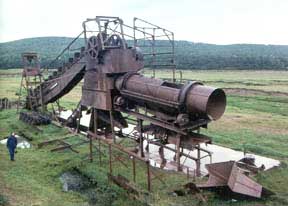
Attempts at mechanization began in 1902, and gained momentum when the American Edson Sutphen inaugurated the first dredge in 1905. This provoked an investment fever, with 20 or so companies being established. By 1906-1907, 300-400 workers were employed on twelve dredges in the north-west and west sectors, as well as a variety of smaller steam- and hydraulic-powered equipment. Despite this increased intensity, aggregate annual yields probably never exceeded 500 kg. The "bubble" burst, and all mechanized activity ceased by 1910.
East Coast (Atlantic)
In 1884, gold was discovered on the sea-coast at Cabo Vírgenes, just north of the Eastern entrance to the Strait of Magellan. This aroused interest in Buenos Aires, and Julio Popper brought a prospecting expedition in 1886. He discovered and successfully developed El Páramo, on the coast of San Sebastián Bay. Subsequently, others worked alluvial sands along the east coast, including the vicinity of Rio Grande. [Photograph shows men working beach sands, near Ea. Cullen, c1940.]
;)
Southern Archipelago
The most productive deposits in Tierra del Fuego were located in the least hospitable part of the region, on Islas Lennox and Nueva, where gold was discovered in 1888. By 1890 over 300 men were at work, both here and on Islas Picton and Navarino; by 1891, over 500; and by 1893, over 1,000, the search extending to Islas Wollaston and Barnevelt, plus False Cape Horn. Returns in these beach sands were generous: in just 3 years (1891-1893), for example, Isla Lennox yielded an estimated 2,000 kg. Yields declined steadily from 1894 to 1902. Several companies were formed around 1905-1907, but they were unsuccessful, and all activity came to a close by about 1910.